
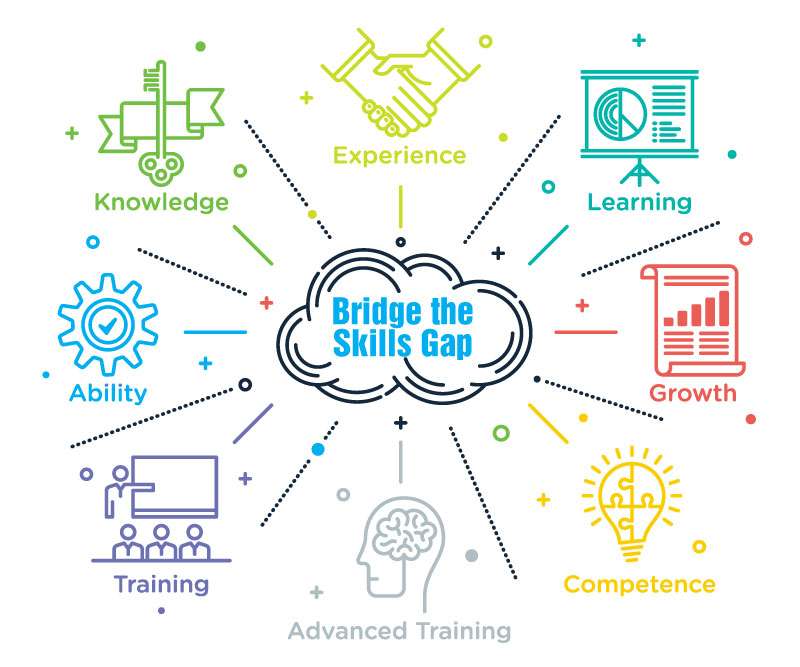
 Skills gap is a topic of much interest in the business, government, and education sectors these days. Defined as a mismatch between the skills workers can offer and the skills demanded by employers, there is debate over whether the United States will face an unprecedented skills gap over the coming decades. This potential gap may lead to persistent unemployment for unskilled workers, while at the same time contribute to a rise in unfilled job openings in sectors such as technology, manufacturing, engineering, and healthcare. On one side of the debate are analysts who say the United States is already undergoing structural shifts as evidenced by low unemployment and a rise in automation replacing less-skilled workers.[1] Alternative theories posit that there is no national skills gap but rather localized hiring challenges stemming from the inability or unwillingness of employers to pay the wages required to attract skilled workers.
Further compounding the debate is disagreement among experts as to what skills are needed in this changing landscape – is it STEM skills, communication, creativity, collaboration, or critical thinking? And further, what role does secondary and higher education play in developing identified skills? There is a growing trend of employers collaborating to identify and create training solutions to solve the skills gap in their specific industry sector.
There are a variety of concerns contributing to perceptions on the skills gap issue. There is no doubt that we have a scarcity of skilled labor in areas such as machinists or technicians who can fix and maintain factory equipment for various reasons like industry having left the region and/or the devaluing of the trades.
In other sectors like nursing, it’s simply numbers – boomers are retiring out faster than people are entering into the field. Young people have more career options today than years ago, particularly women. Additionally people have misconceptions about what opportunities exist in these industries.
It’s also a branding problem. Our youth hear STEM and they think they have to a supersmart nerd to be an engineer or scientist. We need to make STEM accessible, relatable, and connect the learning to the real world by engaging businesses in the process sooner.
While the debate rages on, we know first hand that employers face skills gaps within their organizations. More deft companies are quick to identify existing or impending skills gaps, giving them an edge over their competitors. Bridging the skills gap through training and professional development of existing employees is one way employers can ensure ongoing productivity and profitability. Alternatively, employers can bridge skills gaps with the use of temporary workers until permanent, full-time employees can be hired or re-training can occur.
Equally as important, however, is that employers recognize and reward their highly productive employees and ensure the skills of such employees continue to evolve and grow with the company and its sector as the cost of replacing highly-productive employees is significant (often 2x annual salary)[2]. High quality human resources management, often overlooked as a critical component of a company’s strategic advantage, will most certainly play a role in determining who the “winners and losers” will be in the coming decades. Now is the time for employers to take stock of their most valuable assets – their employees – and make sure they’re skilled and incentivized to contribute to the organization’s long-term goals.
[1] Dickson, George. “20 Surprising Employee Retention Statistics You Need to Know. https://blog.bonus.ly/10-surprising-employee-retention-statistics-you-need-to-know, (accessed 6 June 2018).
[2] Weaver, Andrew. “The Myth of the Skills Gap”. MIT Technology Review. 17 August 2017. https://www.technologyreview.com/s/608707/the-myth-of-the-skills-gap/, (accessed 7 June 2018).